Fresco Painting Definition
fres·co (frĕs’kō) pronunciationn., pl. -coes or -cos.
1. The art of painting on fresh, moist plaster with pigments dissolved in water.
2. A painting executed in this way.
tr.v., -coed, -co·ing, -coes.
To paint in fresco.[Italian, fresh (plaster), of Germanic origin.]
fres’co·er or fres’co·ist n.
Fresco Painting & Sgraffito Glossary of terms
Fresco (Italian: Affresco) – Type of mural painting on plaster used throughout the world since early times, but especially known from its high development in Italy during the Renaissance; hence the use of Italian terms to describe the technique. See also Buon fresco, Lime painting and Secco.
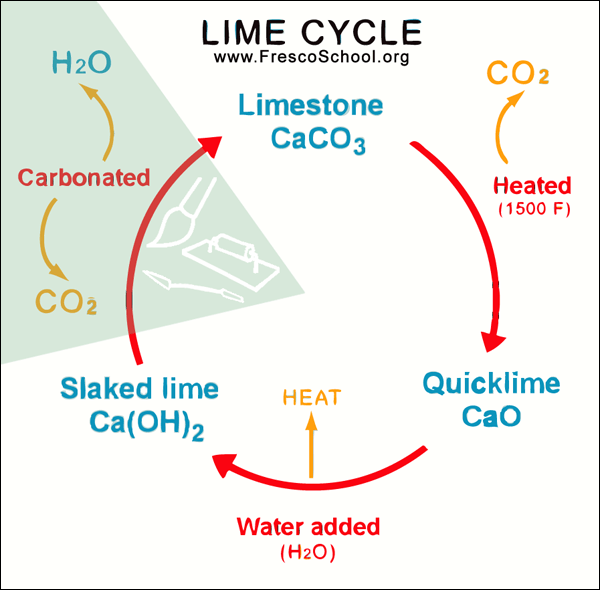
Buon fresco – True Fresco – Method of mural painting in which artist must start applying his colors on the wet intonaco (painting plaster layer) as soon as it has been prepared and laid on the wall/ceiling. The colors can thus be absorbed by the wet plaster. When it dries and hardens, the colors become one with plaster. Technically speaking the plaster does not “dry” but rather a chemical reaction occurs in which calcium carbonate is formed as a result of carbon dioxide from the air combining with the calcium hydrate in the wet plaster..
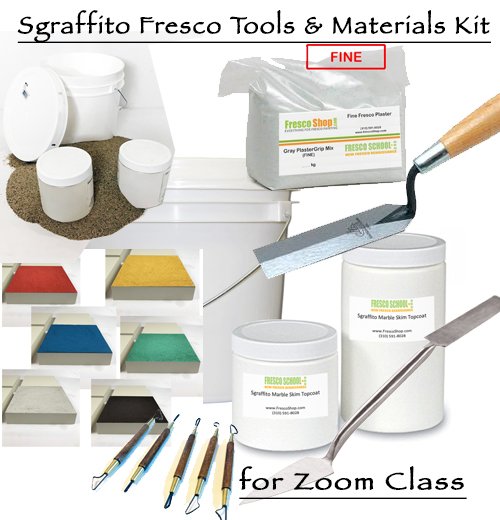
Sgraffito – (Italian: [zɡrafˈfiːto]; plural: sgraffiti; sometimes spelled scraffito) is a technique either of wall decor, produced by applying layers of plaster tinted in contrasting colors to a moistened surface, and then in either case scratching so as to reveal parts of the underlying layer. Sgraffito and sgraffiti come from the Italian word graffiare (“to scratch”), ultimately from the Greek γράφειν (gráphein, “to write”). Related terms include graffito and graffiti.
Similar to Fresco, Sgraffito on walls has been used by all civilizations that have used plasters in their building systems. In Europe we find examples of sgraffito since classical times, it was greatly popularized in Italy in the 15th and 16th centuries. In combination with ornamental decoration these techniques formed an alternative to the prevailing painting of walls. The technical procedure is relatively simple, and the procedures are similar to the painting of frescoes.
Secco Fresco – technique of applying colors which are not resistant to lime over an undercoat, putting the finishing touches on a fresco after it has hardened. Tempera is mixed with adhesive such as gum arabic, casein, animal skin glue or modern day acrylic mediums after dampening down the plaster*. Results are not as durable as Buon Fresco and the painting will eventually flake off beyond repair – Last Supper of Leonardo is an unfortunate example of the limitations of the Secco technique. * (dampening is needed for bringing the surface to a consistent tone – since painting is done in transparent layers and dry plaster would change color to a wet, darker tone as soon as the watery paint is applied.)
Faux Fresco – variety of techniques involving wide range of materials and application methods (mixed media) used to simulate look and feel of boun or secco fresco.
Fresco Cartoon – full scale drawing of the future fresco. Cartoons are drawn on regular paper with pencil, graphite, charcoal, sepia chalk, etc., etc. The purpose of a cartoon is a thorough study and final rendition of the composition, light, shadow, details of the future fresco, it is a preparatory drawing taken to the next level. Correctly done cartoon is a “stand along” artwork. Although optional in other painting mediums, Cartoon is essential when paintng in Fresco not only as the main guideline for transferring the design onto freshly laid (fresco) plaster, but also as the main tool and method of understanding and orcestrating the steps for painting of the corresponding fresco.
Giornata (plural: Giornate) – irregular shaped section that can be plastered and painted in one day. The shapes more or less follow the composition so adjoining Giornate do not not have obvious dividing lines in the finished work.
Lime painting (Calcitta) – The fresco pigments are mixed with lime water or slaked lime, and/or the wall is wetted down with lime water until the plaster softens or a paste of lime is laid upon the wall, also used in paining on setting plaster as part of whats known as “mezzo fresco” technique (some Pompeii frescoes were painted using mezzo fresco). Although it is a less demanding technique the resulting painting is more pastel or chalky and not as durable as Buon fresco.
Intonaco – Finish Coat – the final smoothest coat of plaster on which the actual buon fresco is painted before it dries and hardens.
Browncoat – Arriccio (Ariccio; Arricciato, Arriccato) – a layer of plaster over the roughcoat (Trullisatio) and just under the finish coat of plaster (Intonaco) which will be painted. The sinopia or full scale composition is laid out on the arriccio.
Scratch Coat – Trullisatio – first, base coat of plaster usually scratched with trovel, hence the name. This coat is layed directly on the “chicken whire” mesh, lath stone, or brick. However building a fresco wall directly on a brick is not advised since salts – the main enemy of plaster can collect within the brick due to faulty roof or come up from the ground – unlike the plaster brick will dry much slower if ever.
Fresco Pigment – ground into fine powder natural minerals and oxides that can withstand the alkaline action of lime.
Fresco Paints – fresco pigments mixed into water. For dry (secco fresco) pigments are mixed into the medium that has binding properties, since secco fresco is done on dry plaster. Traditionally egg yolks and/or egg whites or gum-arabics and caseins were used as the medium, novadays acrylic mediums also could be used. (see secco fresco)
Pouncing – technique of transfering of the Fresco Cartoon by pricking holes in the outline through which fine pigment powder is dusted.
Incision – technique of transfering of the Fresco Cartoon by scribing, incising the drawing with the pointy stick (or stylus), usually the opposit end of the brush while it is layed over the plaster.
Perforating Wheel – a tool with revolving toothed head which punches regular holes along the outline of the drawing to be transferred by pouncing.
Sinopia – underdrawing for fresco made with reddish, greenish or brownish earth colour with water brushed on the Arriccio layer, over which the Intonaco is applied before painting. Red earth (iron oxide) mined by the town of Sinopia during the Renaissance period (present Turkey), currently depleted gave the name to the method. During Giotto times and before; Sinopia was the main preparatory drawing. The entire fresco was designed in Sinopia directly on the wall. Cartoons were implemented later, after the perspective was “invented” and more thorough composition development became essential.
Verdaccio – an Italian name for the mixture of mars black and yellow ochre resulting in a grayish or yellowish (depending on the proportion) soft green (Classic Verdaccio Pigment).
Verdaccio became integral part of fresco painting where this color is used for defining tonal values, creating complete monochromatic underpainting. Often architectural details in frescoes are left in Verdacchio without any additional color layers, best example is the ceiling of the Sistine Chapel, where you can clearly see verdaccio underpainting left as is on all architectural details of the composition.
The technique of underpainting in verdaccio became known as “Verdaccio” (see tutorial).
In oil painting a similar technique is used by flemish painters which is referred to as the “Dead Layer”. “Dead Layer” is applied over the traditional burnt umber underpainting to refine the values and remove the warm tone of umber. The resulted “white to olive green to black” underpainting is like “like being lit by a moon light” which does not affect the tonality of the final painting.
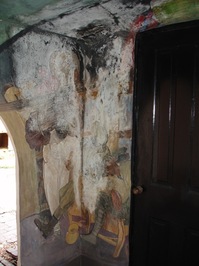 Deterioration of fresco paintings results from the open, porous nature of their support (walls and ceilings of buildings or other carriers) and their interaction with the surrounding micro climates.
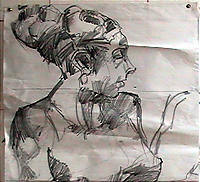 Cartoons are drawn on regular paper with pencil, graphite, charcoal, sepia chalk, etc., etc. The purpose of the cartoon is a thorough study and a final rendition of the composition, light, shadow and details of the future fresco. It is a preparatory drawing taken to the next level. Correctly done cartoon is a “stand along” artwork. Although optional in other painting mediums, Cartoon is essential when painting in Fresco not only as the main guideline for the transferring of the design onto freshly laid (fresco) plaster, but also as the main tool and method of understanding and orchestrating the steps for painting of the corresponding fresco.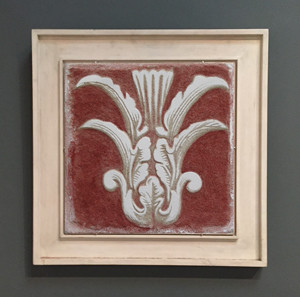
 This guide will answer the question about how to get started with fresco painting in a fast and easy way.